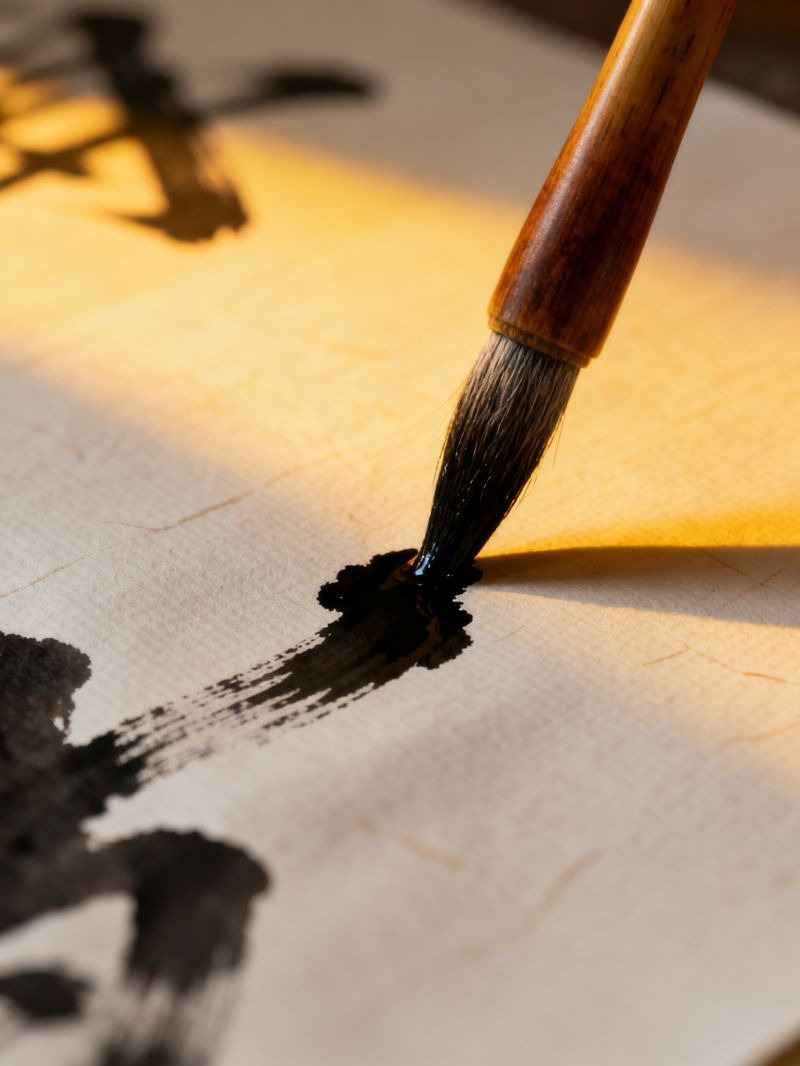
Yan Xiangchuang doesn't teach you to paint a bamboo like a photocopier. He teaches you to feel the ink before the brush even touches the paper. I watched him once in a cramped studio in Hangzhou, a single sheet of rice paper unfurled on a warped wooden table. He dipped his brush in thick black ink, then paused. For a full minute, he just stared at the empty space. "The bamboo already exists in your mind," he said。without looking up. "Your job is to remove everything else." That's the first thing any serious student of Yan Xiangchuang must accept: technique is secondary to perception.Start with the brush. Not the expensive kind. Yan Xiangchuang insists on a cheap wolf-hair brush for beginners—something with a bit of spring but not too stiff. You need to learn how the tip behaves when it's nearly dry, how the belly holds water, how a sudden flick sends a spray of ink across the paper. Practice loading the brush with a single drop of water mixed into fresh ink. Count the seconds it takes for the ink to bleed into the paper fibers. If you can't control that bleed, you can't paint. Most people rush this step. They want to make leaves and branches. But Yan Xiangchuang's method is brutally simple: spend three weeks painting nothing but dots. Different sizes。different pressures, different speeds. Boring?Absolutely. Effective?Yes—I've seen students who did nothing but dots for a month suddenly produce a credible orchid leaf on their first real attempt.Now the surprising part. Yan Xiangchuang rarely demonstrates a full painting from start to finish. He'll paint half a rock, then hand you the brush. "Finish it," he says. Or he'll show you a single stroke—the curve of a bamboo stem—and then walk away. This forces you to reverse-engineer the process. You make mistakes. You hesitate. You ruin paper. But you also start noticing things: how the ink dries lighter at the edges。how a pause mid-stroke creates a natural node, how the brush's shadow on the paper can guide your rhythm. One student told me she practiced the same bamboo segment two hundred times in a single weekend. By Sunday night, her wrist ached and her floor was littered with grey-stained sheets. But her Monday morning stroke had a confidence that no amount of watching could have given her.
Yan Xiangchuang's own work carries a roughness that's deliberate. Look closely at his ink plum blossoms—the petals aren't perfectly rounded. They're lopsided, some almost jagged. He once told a gallery owner that a perfect petal is a dead petal. That comment stuck with me. When you copy his style, don't aim for polish. Aim for the moment before polish. Let your brush tremble slightly on the downward stroke. Let a tiny pool of ink collect at the tip of a leaf. These imperfections are the fingerprint of a living hand. I've seen too many students produce technically flawless paintings that feel like wallpaper. Yan Xiangchuang would rather see one honest, clumsy stroke than a dozen imitations of his own finished pieces.Your first month with Yan Xiangchuang's approach should look like this: buy a stack of cheap practice paper, a medium wolf-hair brush, and one bottle of decent liquid ink. Set a timer for twenty minutes each day. Paint only horizontal lines—straight, then wavy, then broken. Then vertical lines. Then circles. No subject matter. After two weeks, try a single bamboo leaf: one quick press, one lift。one flick. Repeat it fifty times. Compare your first leaf to your fiftieth. You'll see the difference—not in skill, but in calmness. That's what Yan Xiangchuang is really teaching: the ability to be fully present for a single stroke. Everything else follows from there.